Tuesday, June 4, 2013


Day 6: Turtles, take two.

Good morning!  Believe it or not we actually got a chance to sleep in this morning. Due to our late night turtle watching we were rewarded by a 9AM breakfast as opposed to the usual 7AM breakfast that left half of us feeling like we re going to fall asleep and end up face first right into our rice and beans. After taking turns setting up and taking down the dishes, we gathered up our journals and school supplies and piled into a classroom to learn more about the sea turtles. 

Stami's excitement was instantly contagious and everyone's eyes and attention were drawn to her. Through a PowerPoint presentation, pamphlets, and specimen samples she went into detailed descriptions about their habitat, eating habits, and population problems- both natural and human causes. According to Stami, out of the three turtles found in Costa Rica (the Leatherback, the Green, and the Hawksbill) all are on the verge of extinction. This being so, turtle preservation places such as Estacion las Tortugas are essential in keeping the species alive. Their efforts include turtles patrols (like the ones we assisted in) where in different groups 3 kilometers of land are patrolled from 8PM-12AM and 11PM-3AM to protect the breading turtles from poachers. Being that the turtles are at such a risk, any interference with them is a federal offense that is strongly enforced. it was explained to us that these poaches hunt down the eggs and sell them. They are often used in bars and used raw as a shot, which is considered to be a natural aphrodisiac. The eggs aren't the only thing in danger from these poachers though. Sometimes the whole turtle is stolen from the beach and used for meat or their shell is used for jewelry. 

Once class was dismissed we filled out of the classroom and had recess (free time). Some people took naps trying to recover from the long night while the rest of us laid beachside in hammocks in-between palm trees taking in the day. As the waves crashed upon the coast and the light, warm breeze blew our hammocks, we couldn't help but feel at complete peace. For those select moments, all the heat, humidity, and mosquitos seemed irrelevant and we just existed in the world around us.  Some us of took a quick walk to explore the local forest.  We picked up a few coconuts and had the opportunity to taste the coconut water and eat some of the coconut meat!


Later in the afternoon we did a service project with the volunteers of the turtle research station.  We worked to help prepare a new nursery area for the turtle eggs.


Before dinner we headed out in boats to explore the surrounding area to see what wildlife we could spot.  We were thrilled to be moving on the water as it kept the mosquitos at bay!  Our water adventure turned up a wealth of animal life.


Around 5:30 we were informed that a batch of hatchings had emerged from their nests and were to be set free into the ocean. As smiles filled our faces and we clenched onto our camera we filled into the work station to watch one of the workers put the small little turtles into a crate to transport them to the beach. As we gathered behind here like anxious children peering into a toy store window we followed her out to the beach snapping as many pictures as we could. Once we got to what she described as the perfect place to release them, she tuned the crate over and the race to the sea began. The little turtles move their arms and legs with such force and strength it was almost hard to believe they had just  been born mere hours ago.  The stronger turtles reached the wet sand first and headed towards the surf.  Other, lagging behind, continued to work 
                                                                                                     their front and back fins making progress that had to tire them out.  We cheered, encouraged them and followed slowly as they made there way through the drier sand to the more moist beach.  Eventually, they were all swept up by the rolling surf.....off they went on their journey of survival.  For some, the journey would be short for they would end up as dinner for some of their predators.  Others, would make it to the deeper seas to only lose their life to a predator.  Only one in a thousand hatchlings makes it to adulthood.  Our efforts were increasing those odds.


When dinner rolled around that night we were all surprised (and slightly overly excited) to find that they had created a dish of spaghetti and garlic bread for us! As our mouths watered with anticipation, we realized they must have over heard our conversations about missing some home favorites. Once again the kindness of these Costa Ricans blew our minds and touched our hearts. After everyone went back for seconds (and even some for thirds) we wrapped up dinner and suited up for our final turtle patrol.

We met in the dining hall at 7:45 for our final turtle patrol.  Half way through our walk, with no turtles yet spotted, we were feeling slighting discouraged. Then, like an act of fate, our guide noticed little tracks leading from one of the nest towards the ocean; and sure enough after shining the infrared upon the sand we saw little turtles making their journey towards the sea. As we tried to hold back our squeals of excitement, the guides went to work scooping one up to take back to camp for data measurements. As we briefly head away from our patrol posts and back to the facility to measure the baby we all took turns holding him/her in our hands (turtle gender is determined later in life depending on what temperature the turtle choses to live in). As we each took turns we couldn't help but feel overwhelming senses of joy. This little creature that squirmed in our hands was only there due to the efforts of these people who sacrificed their lives so that these turtles could have a chance at life too

As the evening came to an end, we returned to our bunks, crawled under our mosquito nets and reminisced about all we had the opportunity to be a part of that day. Watching observing and experiencing the awesomeness of nature forces you to reflect on your role in the world. In our busy lives full of schedules, bills, and obligations we forget how small we actually our in this world. The bigger picture became clear for us today though, and it was beautiful.

Love from all in Costa Rica,
Pura Vida! 


Saturday, June 1, 2013


Day 5: Estacion las Tortugas

Today was a bittersweet day. We had to say goodbyes to our new friends and family at Monserrat, but we were ready to experience more of Costa Rica.  Thank you Montserrat, Margherita, Favio, Blanca,  Alejando, Wendy and Lucia!


Once our goodbyes ended, we reunited with Gabriel and started our journey towards Estacion las Tortugas where we will be helping to protect leatherback sea turtle eggs and hatchlings from poachers and other natural dangers. 

Some of us managed to take short naps on the bus, but it was hard because the road is very bumpy (and as you know, Gabriel drives like a maniac). After a two and half hour ride, we had the pleasure of meeting Adrian's mom, Senora Nila. We picked up her up on the way to a local restaurant that Adrian frequently visits. Lunch was delicious! We had the option of eating chicken, fried fish, pork chops, or beef…nonetheless our plates were licked clean and we even had dessert!  Our ice cream dessert was very yummy.

After lunch we dropped off Adrian's mom and briefly met his beloved dogs. We were now off to our first school visit, and to our surprise it was the school Adrian attended as a child.   This is a small school on the Caribbean Coast.  The school is home to about fifty students.  The students range in age preschoolers to eighth grade.   The school has large windows that face the street and the wire mess covering the windows allows the breeze to blow through freely, when there is a breeze.


Right as we came off the bus, the students greeted us at the front gate by grabbing our hands and walking us around the school to give us  tour.  Some of our girls played a quick game of soccer with the students.  Soccer is the football of Central America and the game of choice.  Everyone puts their blood, sweat and tears into this game regardless.  At first we were hesitant to play thinking we might hurt one of the kids but we quickly learned we were the ones who needed to be concerned for our own well being.  The kids threw themselves into the game and played fast and furious.


The game went back and forth with the ball flying in all directions.   One side finally scored a goal and the competition bar was raised.   Finally the game ended as a tie with both sides scoring a goal.  

After the game we headed back to the classroom in order to be introduced and present the students and school with our gifts. 

It was very heart warming to watch their faces light up at the sight of gum, crayons, glue sticks, and toys. 


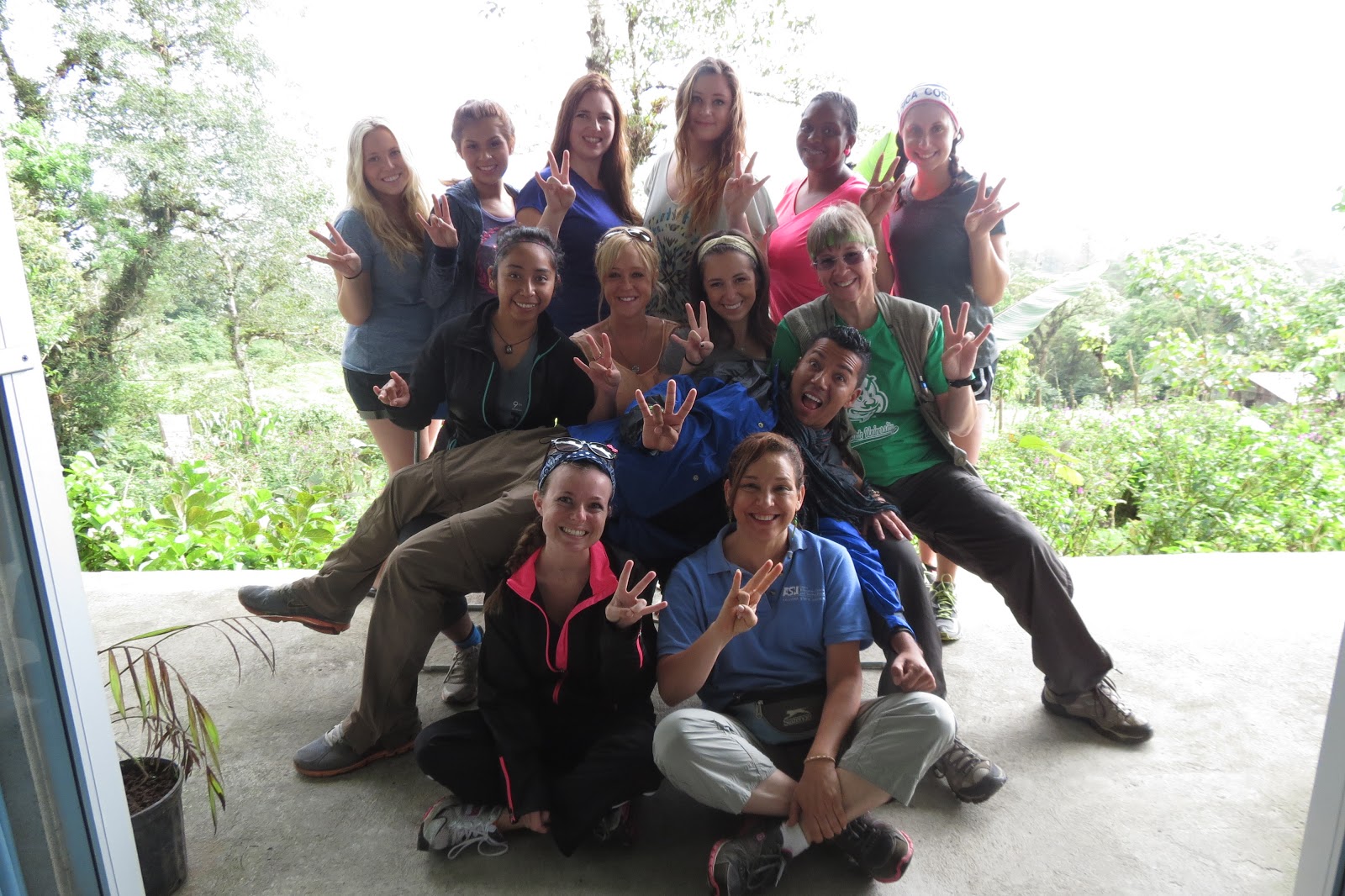
To conclude our short visit, we took group pictures, and said our "see you laters". It was time for us to continue our voyage to the Caribbean coast. To give you an idea of the Costa Rican roads, our trip took over four hours and it was only sixty miles.


Before our bus trip ended, we passed through banana and pineapple plantations.   As we passed by the banana plantation, Gabriel made a quick stop.   We piled off the bus and followed Adrian into the banana field.  Adrian explained that the banana tree is a female but has both male and female flowers.  The female flowers turns into the bananas with the male flower turning into the shell around the bananas.

The blue bags are placed around the developing banana's to protect them from blemishes.  All grade 1 banana's, no blemishes, are exported.  Any banana with a blemish is considered a 2nd or a 3rd.  A 2nd banana has a brown spot or something that does not change the 

taste or quality but appearance.  This is sold in Costa 
Rica.   Grade 3 bananas are made into baby food.   These 3rd category bananas might have a bruise that is seen on the banana's meat.  This can be removed and made into the pureed baby food.

All banana trees have three trunks because they are three generational trees.  One trunk is the baby, which is the newest trunk.  One trunk is the mama and the last trunk is the grandma.   After three generations the entire banana field is cut down, removed and new baby banana plants replace the entire field.
The mama trunk carries the banana's.


The pineapple fields we passed covered much of the land on both sides of the road for miles.  Pineapples are from the bromeliaceae family.  These plants are plant every which way and not in rows.  The pineapple grows at the crown of the plant, possibly flowering in 20 - 24 months and fruiting in the following six months.  The pineapple plant produces a pineapple once every four years.  The pineapple plant is short, stocky stem with tough, waxy leaves.  Costa Rica and Hawaii provide the world with most of its pineapples.

Back on the bus we headed down the road to the docking station where we will pick up the boat that will take us to Las Tortugas - TURTLES!!!!!


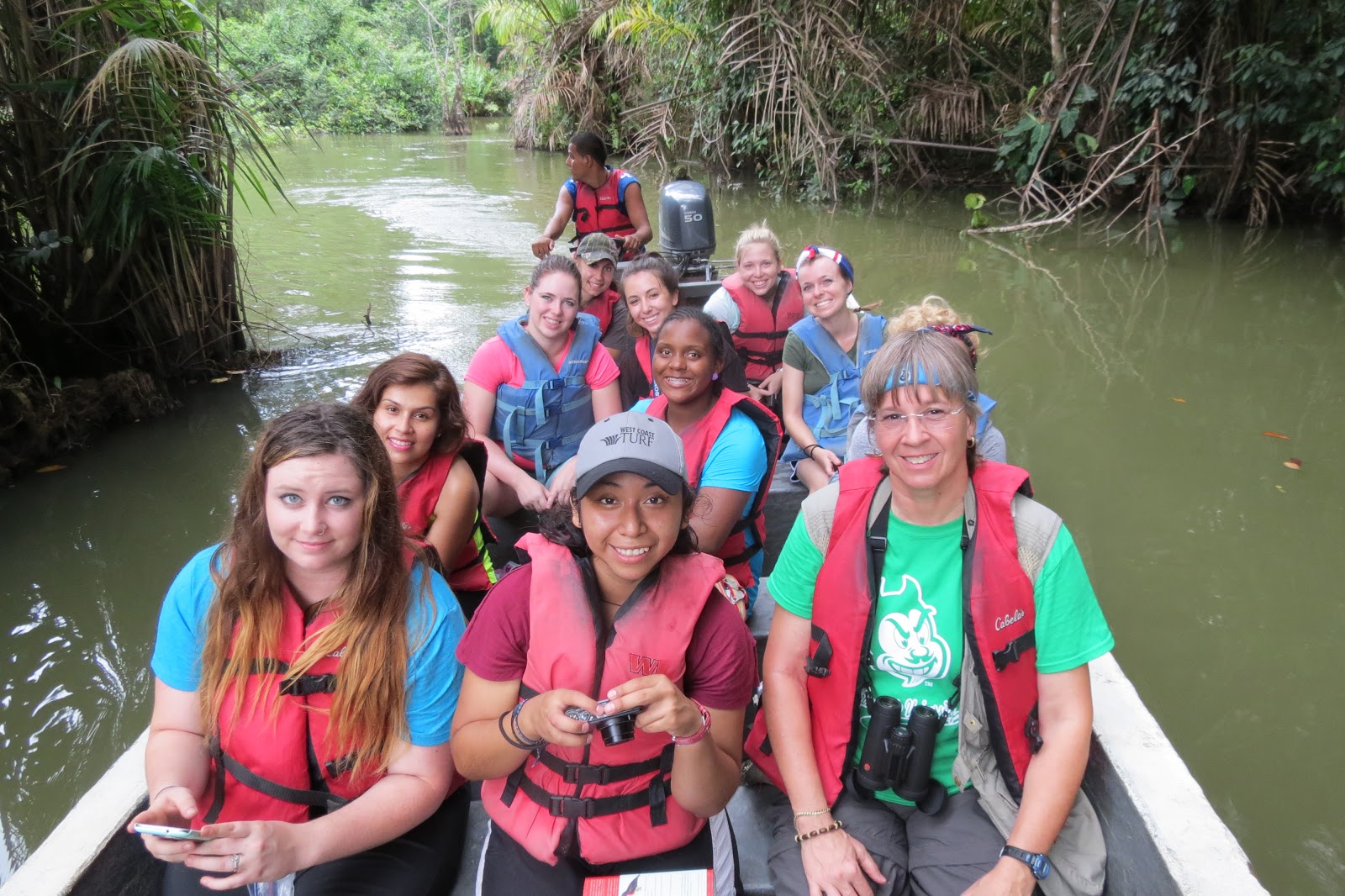
Our bus reached the dock and we quickly pile off.   We begin removing our luggage and carrying them to the boat.  Our short boat ride takes us through a small canal surrounded by rainforest and leads us to our new home, which will be so for the next two nights.  We were embraced by humidity, tasted by mosquitos, and welcomed by the people.   Our travel to our island was a new adventure.   The breeze cooled us off and kept the mosquitos at bay.  The sounds of the jungle reminded us of the Rainforest Cafe minus the elephants!.   We jetted over the brackish water which are home to caiman and crocodiles.  The trees were alive with birds from tips of the trees to the forest floor.  Basilisk and lizards roams the branching that hung over the waters.......

Soon we arrived at the shore that would start our short journey to camp.  Once in camp we were assigned rooms and quickly dropped off our belongings.   After settling in, we had a quick orientation of the camp and learned the 'do's and don'ts" of island life.   We were introduced to the camp staff and greeted by  Stami, the lead turtle researcher.

Soon, it was time to eat again!  Dinner was in the main dining area which was a family style set up.   Each of our rooms was assigned a meal duty of either set up or clean up.   The first group set up dinner by setting the table and placing food on the two tables that would be ours.   Our group has really bonded so we were not short on conversation!

After dinner the excitement begin to grow as we prepared for our first sea turtle patrol which started at 8 pm. The eleven of us were split into two groups, each group patrolled a different part of the beach: Group 2 patrolled stations 0 - 15 and Group 1 patrolled 16 - 25.   Group 1 headed out first since they had to walk down to station 16.  Five minutes behind, Group 2 headed out for their patrol.


Group 1 had been walking less than ten minutes when we
were lucky enough to spot a sea turtle already on the beach preparing to lay her eggs.  It was pitch black outside, the moon shine was covered by a dense layer of clouds.   The moon was waning since full moon was only three nights prior.  The waning moon could have allowed us a nice moon glow to see where we were walking.   Instead, the darkness made it was very difficult to see the turtle.  Once we got closer and as our eyes adjusted to the darkness, we were all able to make out the turtles outline and were amazed at her size. We waited for Group 2 to catch up to us since this turtle was at station 6 which was in their territory.  That group stayed behind to help the turtle deliver her eggs and in relocating the turtle's eggs closer to the hatchery to prevent poachers from stealing the eggs. All of this involved waiting for the turtle to finish cleaning the area preparing it for egg laying, digging her hole (about 70 cm deep), and enter into a trance where she begins laying her eggs (80-100 fertile eggs and 15 - 20 infertile eggs). Right before she started laying her eggs, our guide held a plastic bag in the turtle's hole  and under her tail in order for us to safely relocate the eggs. This whole process can take up to an hour and a half. Once all of the eggs were in the bag, we measured her shell's length and width (length was 162 cm or over five feet  and the width was 70 cm and the weight is close to 900 pounds), and checked to see if she was tagged (if not, they tag her). Another guide dug a similar hole farther from the shoreline to protect the eggs from poachers. We laid flat on the sandy ground and carefully placed each egg deep into the replicated nest. For the rest of the remaining hours of duty, we patrolled the beach in case more sea turtles came. 

Group 2, had the joy of helping hatchlings find their way to the sea.  The hatchlings were digging their way up and out of the sand and our job was to see them safely to the oceans edge.  We do not carry them all the way to the ocean as the struggle to dig up and out and to practice moving on the sand develops strength for their swim and survival.  Group 1 did not help in relocating the first turtle's eggs since they had already moved down to their station location, however they did come along another opportunity 30 minutes before their shift ended and worked on yet a second turtle.  They repeated the entire process described above with their turtle which lasted till about 1 am. 

This was all of our first experience with sea turtles and to have two turtles on our first night was amazing.  This is the end of the Leatherback turtle birthing season.   We will never be able to explain how amazing the process is and how blessed we are to have aided in helping to preserve leatherback sea turtles. We hope our efforts will make a difference and we hope our description made you feel as if you were there a well.

Love from all in Costa Rica.
Pura Vida!

Friday, May 31, 2013


Day 4: Monserrat School Visit/Community Service

Today marks our third and final day in the Monserrat Cloud Forest. The past two days have been full of learning, hiking, and more learning with a concentration on the flora and fauna of the Cloud Forest.  Today is our day to give back to the Costa Rican community of Montserrat with a service project focused on their little community school. The majority of us gals hopped into the back of a light blue pick-up truck and took a short, but very bumpy, fast, and hilarious ride to Monserrat School while the others jammed out to the radio in Margherita's small SUV. This school was a sight to see.  A long narrow building sitting on the crest of a hill, it contains four rooms: a classroom, a cafeteria, a library, each measuring about 12 by 14 and a very small bathroom measuring about 4 by 5.  Six children of different ages and grade levels make up the student body of the school with one teacher, Maria, who gives four lessons based on grade level each and every day.  The students live in the surrounding hills and walk to and from school, rain or shine.  All of the student wear uniforms which consists of a white polo or button down shirt and a navy skirt, shorts or long pair of pants.  
 

Since most of us are education majors 9/11, and even those of us who are not, we were amazed by this teacher and how well behaved her students were.  First, we took a tour around the yard. Down, in front of the school, there was a swing set and teeter totter that look like they could use some help, but the children played happily without any notice of it's imperfections. To the left of the building stands the small greenhouse the ASU students from 2012 built.  Bordering the right side of the school is a row small rose bushes and hibiscus that were partially in bloom.  A chain linked fence surrounded the total school grounds.   Looking around at this school, its yard its equipment, the children, forced all of us to take a step back and reflect at every detail of our own lives, causing us to realize how many things we all take for granted, and marvel at how lucky we all were during our school careers.


Next, we stopped by the green house that was built by the ASU 2012 Costa Rica students who traveled here last year. Every few months, the teacher and the students take time to plant seasonal fruits and vegetables that they later harvest and give to the children and their families. Currently, they had planted radishes, and are planning to plant strawberries next. It is nice to see that the project complete last year by the ASU ladies is still very meaningful to the teacher and students who attend Monserrat K-8 

school.  We were very excited to have the 
opportunity to add to their joy by offering our own service project to beautify and preserve the well warn school. Knowing that Maria was so proud of the green house, we instantly felt the pressure to impress her just as much this year with our contribution as they did last year. Our gift......to prepare and paint the entire outside of the school.


Our duty for the day was to prepare the outside of the school to be repainted.  The plan was to spend a few hours working, then have a lunch break, and finally finishing working until about 4pm. It may sound like a simple task for eleven girls to complete, but we soon found out that it was much more difficult than we had anticipated. After a few misunderstandings, many good ideas that failed, we finally figured out how to go about sanding down the old paint and slapping on some new colors. Even though there was some frustration with how long it was taking to remove the old paint, we all worked our butts off and felt accomplished with the work that we completed. We may have even walked away with futures as painters if teaching doesn't work out!   Or not.

Half way through our day we were invited to break for lunch.   The family across the road from the school prepared and served us our lunch.  Our lunch consisted of 
rice and beans, salad, chicken and juice.  It was very delicious.   The meal was prepare in an outdoor kitchen.   The thatched roof covered the six wood tables.  We sat among the tables eating and enjoying a light rainfall.   During our luncheon, we watched the local news on the outdoor television set.  At one point during our lunch the news was covering local topics and we watched an interview with Margherita about the area.   We were all so impressed with seeing Margherita on television.    We screamed for her to come and see.   Margherita is a very humble person who did not and does not make a big deal about her accomplishments.

After lunch and with full bellies, we returned to the school to complete the painting of the outside.  Within a couple of hours we were at a stopping point.  Clean up took just as much time as the prepping of the building.

Even though we had an early start to our morning,  believed our task to be a piece of 
cake, and that we would finish with plenty of time left to do even more, we were only able to finish painting a portion of Monserrat 

School. Although this disappointed us, we instantly received much appreciation and gratitude for giving our time. The joy it brought us to see the community so happy with what we did, even though we didn't finish, reinforced our love for the people of this country. Most of us, along with most Americans, do not take time to help others unless there is a national, devastating disaster. Today helped us realize that being a volunteer is rewarding and we ask all of you to try to spend more of your free time volunteering to those in need.  It is very gratifying to give without an expectation to receive something in return.  The appreciation from the community was heartfelt and softened our hearts.


We are all sad to say goodbye to Monserrat and its people. This community and its people have been more helpful and welcoming than we could ever ask for. We all became a small family, and they will be missed dearly. Tonight we will spend our time taking in our favorite place (at least so far). Our agenda for our final night will contain a few of our favorites: singing songs native to Costa Rica, playing games, and growing life long friendships.

Buenas Noches!
Love from all in Costa Rica.
Pura Vida!


Day 3: Hike, Hike, Bird.

Buenos Dias! Saludos desde Costa Rica (Good morning and greetings from Costa Rica)!!  Today, our day was exhausting and full of excitement.  We began Monday ( May 27th) with nature shaking our bunk-beds because we experienced our first earthquake in Costa Rica (according to Adrian, our tour guide, the earthquake had a magnitude of 5.7.) But, no worries family and friends, we are all safe and sound. Some of us (Patty and Abby) didn't even notice their bunk beds swaying from side to side and just kept right on snoozing while others were cautiously calling for Dr Mo!  This 3:40am wake up call did not prevent us from quickly calming down and falling back to sleep.

Two and a half hours later  we were ready to birdwatch with Dr. Mo, Margarita: our amazing biologist, and Adrian.  Equipped with knee high rubber boots, binoculars, cameras and water bottles were set out to enjoy a sunrise and the sounds of the forest coming to life.  While we were out, we saw beautiful birds - some of which we recognized from our "Mo bird teaches" back in Arizona and others that were brand new. As Mo would call it, our bird list 'firsts.'   It was an amazing walk as well as a learning experience. The birds in the Cloud Forest range in size, color and shape.  Margherita is an amazing birder,   she can hear a few notes of the call and identify the bird making the sounds.  She and Dr Mo were quick to locate the birds, help us find them in our binoculars and spotting scope then show us in their bird books so we could confirm and place in our memory banks the color, size and shape!  The colors of the birds in the cloud forest are vibrant!  As the bird flitters to and fro, they flash their colors.  


We learned that usually it is the male bird that is most colorful so they can attract and gain the attention of the female.  In no time we had accumulated thirty-eight different species we had spotted!


We returned from our bird-watching experience and had a traditional Costa Rican breakfast back at the Lodge.  The breakfast consisted of fruit, scrambled eggs, rice, beans and hand-made corn tortillas ( note, these tortillas are quite different than the Mexican tortilla). Nevertheless, they were delicious!  Along with foods, we had costa rican coffee and juice.


Soon we were off on our next adventure.  Our morning hike was to be a hike through the Cloud Forest.  The goal was to experience the flora and fauna up close and personal. Though we thought that we were going to start our walk by walking through a cow             

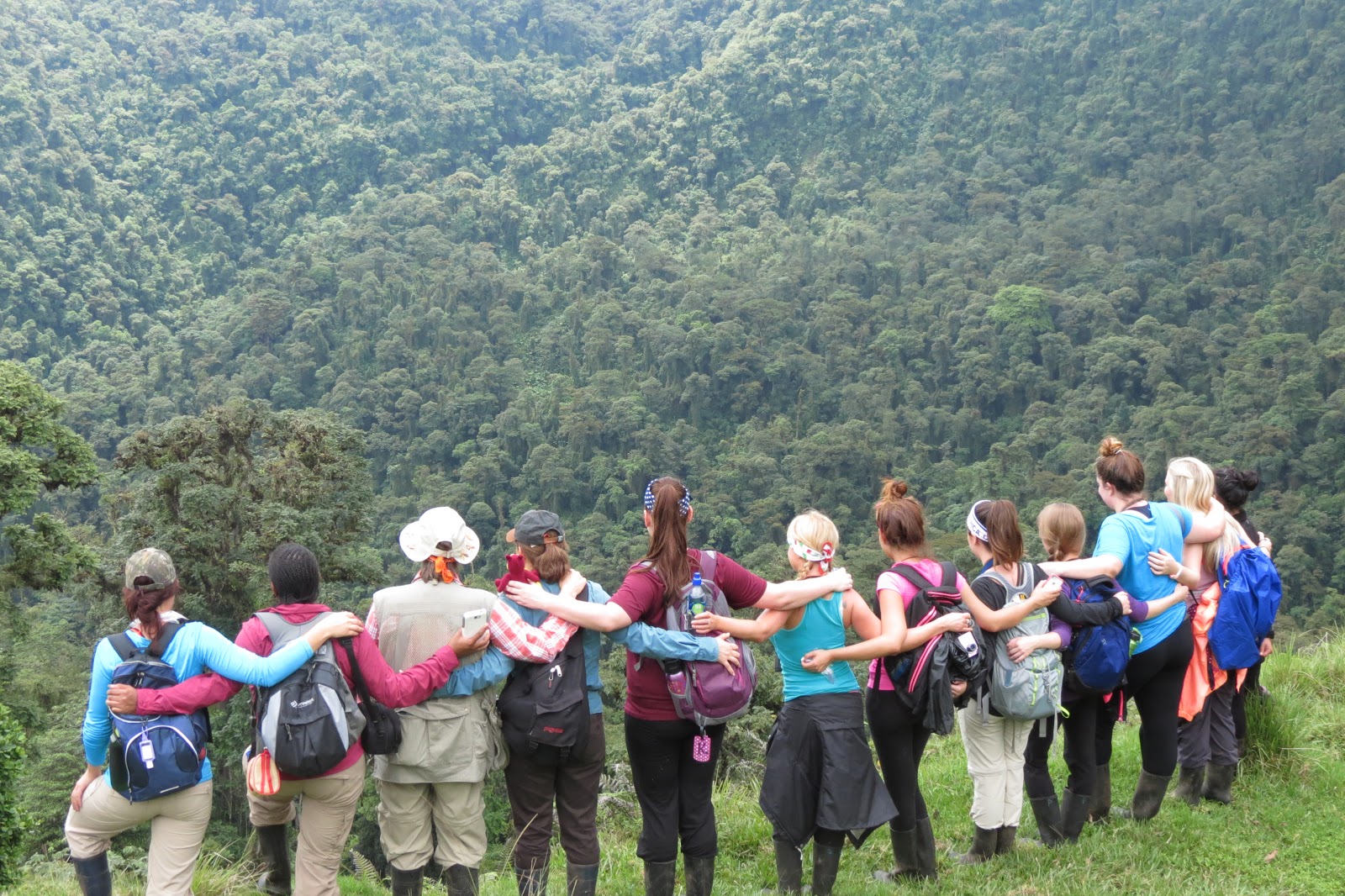
pasture, we ended up walking through what seemed like the opening scene in the movie The Sound of Music.  The ground was soggy from the early morning rain and normal misty conditions.  We sloshed along watching out steps and enjoying the immense beauty of our surroundings.  After about 40 minutes, which included Dory getting her boot stuck in the mud, we came to a beautiful look out.  We were high up and were able to see the thick rainforest in the distance.  It was so gorgeous that so many photos were taken, we felt like  
     we were going to prom. We started through what is known as the Cloud Forest of Monserrat. On our journey we walked through a narrow path filled with rocks and mud that at times reached up to our knees.  

The jungle was dense and the amount of light reduced drastically.  Every once is awhile we would come to an area where a tree had fallen and the sunlight streamed through the opening enhancing the different colors of green.......   The the next thing we knew Adrian was missing from the pack.  When he rejoined the group we learned he experience a wasp battle and the wasp won!  He was the proud owner of a wasp sting and welt. Though Heather was bummed that we didn't find any snakes everyone's bladder had moved from empty to full and it was time to start heading back.  On our way back to the lookout we were once again stopped to see a rare bird that was playing hide and no see.  However,  with  Margherita bird calls and Mo's ambition they were able to track it down.  Though the hike in was pretty easy going, mostly down hill, going back to the learning center was a much bigger challenge, it was all up, up and up.  It was now time to climb up those rolling hills, which basically felt like a 90 degree angle. Though many of us fell in mud, ran out of breath, and required Fabio's rescue efforts we all made in back in relatively one piece.  For those of us who do not hike much, the hike was a challenge.  However, the experience....the beauty....the new experiences made it so worth the effort.

After surviving the much difficult tiring journey through the cloud forest, we came back to another lovely lunch spread. You would think that everyone would be starving and wanting to devour all the mouth watering food,  most of the girls solely desired a shower and a nap!  

As a service project to Monserrat and as one of our assignments for the Cloud Forest, we were scheduled to observe and record the interaction between animals and plants.  The goal was to record how many and which type of animal visited a plant.   We were also to make observations about the health of the plants which included recording the herbivory, bit marks from animals and if anything like moss or lichen was growing on the plant or plant stem.   Each girl was assigned two trees/bushes to watch for animal activity. Everyone went in pairs or groups and took notes of the different activity on each plant. We collected all of our data and made sure to give it to Margherita. All of our hard work will be combined with last years ASU group work into a book to map the area (to look at how the plants effect the animals and how they work together in an ecosystem) of the cloud forest. 

After our research project, we enjoyed yet another delicious dinner.  Our dinners were family style.   We all sat around the U shaped arrangement of tables eating, chatting and laughing a whole lot.  After dinner we lined up to take our cold shower, even though there is a change of hot water!    Another wonderful day of exploring Costa Rica was under our belt and a forest filled choir fill our night of sleep. On to another day!


With love from all in Costa Rica
Pura Vida